







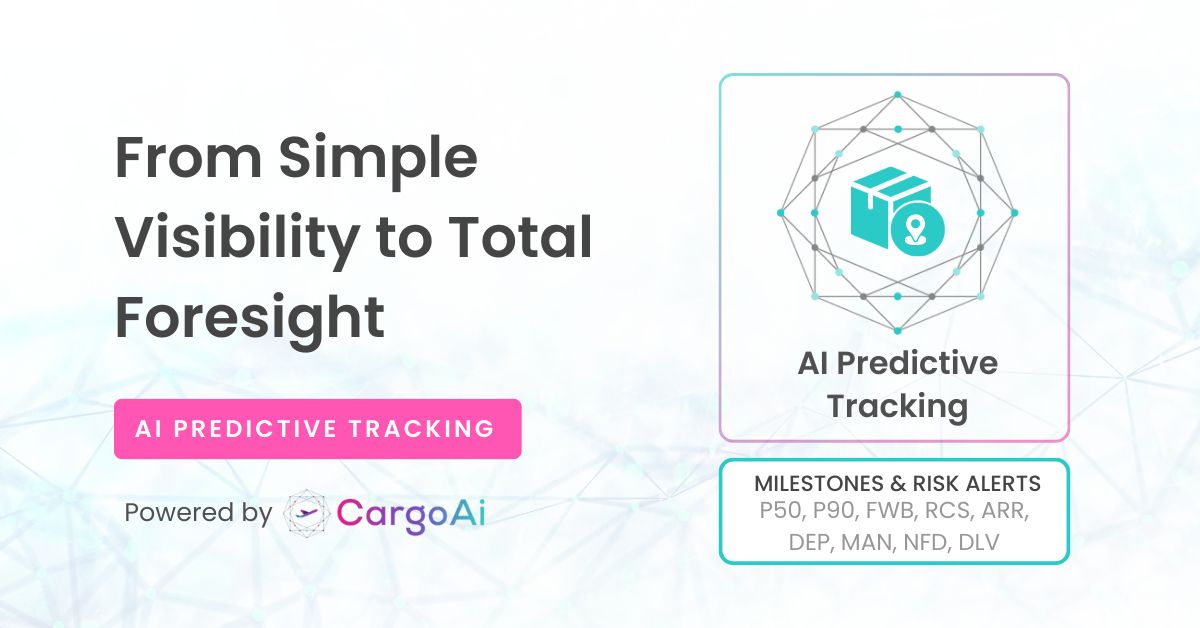
CargoAi has launched an AI Predictive Tracking capability designed to help users anticipate operational risks and shipment delays before they materialise. The solution is available in both CargoMART and as an add-on to the CargoCONNECT Track & Trace API.
CargoAi says that while traditional tracking tools provide visibility once milestones are reported, they often leave limited time to act when a shipment is at risk. Predictive Tracking introduces an additional layer of intelligence by forecasting upcoming shipment events and triggering early risk alerts.
It uses machine learning models trained on millions of historical shipments and live flight updates to predict the expected timing of each key milestone in an air cargo journey. These include documentation submission, acceptance, manifesting, departure, arrival, freight availability and final delivery.
Instead of relying solely on reported events, the system generates probability-based predictions, including median and conservative estimates. These are continuously refreshed as new information is received.
Airlines can identify shipments that have not reached acceptance or manifesting before cutoff and are therefore at risk of missing their planned flight. Alerts can be triggered to intervene, release blocked capacity, or prioritise high-risk shipments. The data can also be used to benchmark station performance and identify recurring bottlenecks.
Freight forwarders gain early visibility on shipments flagged as “At Risk,” allowing them to act on missing documentation, coordinate pickups, or proactively inform customers. Predicted cargo availability can be shared downstream to improve planning and customer communication.
Ground handling agents and system integrators can use predictions to prioritise acceptance, automate pre-alert management, and feed predictive risk levels into internal dashboards or SLA monitoring tools, reducing the need for manual checks.