







Home Blog Page 98

Global air cargo set for double-digit growth in 2024 

0

Global air cargo set for double-digit growth in 2024 

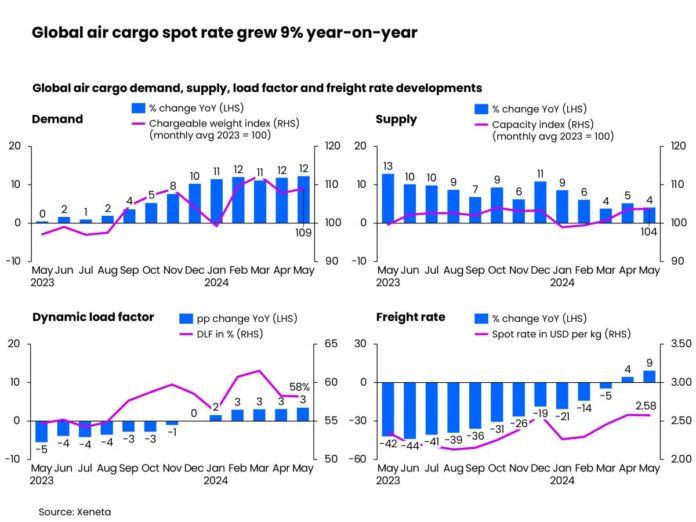
The global air cargo market is on a pathway to double-digit growth in volumes in 2024 after a +12% year-on-year jump in demand in May, according to the latest data analysis by Xeneta.

Despite conservative, low single digit forecasts at the end of last year, expectations have been boosted by six consecutive months of ‘quite extraordinary’ regional demand. The global air cargo spot rate in May consequently registered its second consecutive monthly growth, rising +9% year-on-year to $2.58 per kg, and up +5% pts month-on-month.

Xeneta’s chief airfreight officer, Niall van de Wouw, said: “In terms of growth data, analysts sometimes say ‘once is an incident, twice is a coincidence, and three-times is a pattern’. In the world of air cargo, there’s an undeniable pattern emerging. We can’t use the word ‘surprising’ anymore. When we take a mid-term view of the market, with these kinds of numbers, we might be on track for double-digit growth for the year. It is now a possible scenario.”

While the growth in general spot rate must be measured against a low comparison in May 2023, van de Wouw says the market this year adjusted well to absorb the +5% increase in airlines’ summer capacity.

The highest year-on-year rate increase for May was the +110% rise in the spot rate on the Middle East & Central Asia to Europe corridor, to $3.21 per kg due to continuing Red Sea disruption. Southeast Asia and China to North America spot rates rose +65% and +43% to $4.64 per kg and $4.88 per kg respectively, while China-Europe spot rate also recorded double-digit growth, up +34% year-on-year to $4.14 per kg.

Dynamic load factor in was largely unchanged month-on-month at 58%, but up by +3% pts year-on-year.

How companies see the current market, van de Wouw acknowledged, depends on which region they are active in. Spot rates from North America and Europe to China fell -32% and -23% year-on-year respectively in May to $1.61 and $1.65 per kg. The Transatlantic market also suffered with the corridor experiencing freight rate declines in both the front and backhaul lanes. Increased belly capacity due to summer passenger travel led to drops in air cargo spot rates.

Europe-North America spot rate declined -21% to $1.77 per kg in May versus the previous year, while, eastbound, the North America-Europe corridor spot rate was -16% lower at $1.08 per kg.  

Heading towards the second half of the year, van de Wouw pointed to other positive market indicators. A bright outlook for Q4 2024 may be on the horizon following last year’s bumper end-of-year volumes. This may also be helped by a threefold increase of ocean container shipping spot rates from the Far East to North Europe and the US West Coast compared to the previous year, due to port congestion and wider disruption caused by conflict in the Red Sea, reducing the cost gap for shippers or forwarders contemplating a modal shift to air cargo.

A major shift of volume from ocean to air, however, is unlikely, Xeneta says. Compared to the onset of the Red Sea crisis or the Covid pandemic, cost spikes this time around are most likely triggered by shippers frontloading imports ahead of the ocean peak season to eliminate impacts from increased supply chain disruptions.

China’s cargo market to North America continued to gain from the resilient US economy and its strong e-commerce demand. The big question for the air cargo industry is what happens following the US crackdown on e-commerce shipments from there?

Van de Wouw comments: “At the end of 2023 we saw the dramatic impact China’s e-commerce behemoths had on the air cargo market. Everyone is now waiting anxiously to see what happens in the upcoming peak season. But if the potential rising costs and increasing transit times of e-commerce ex-China leads US consumers to procure less and less, that can have a ripple effect globally.

“If fewer freighters are required to carry e-commerce, they will enter the general air freight market (again) and produce a noticeable supply impact, putting downward pressure on rates. This possibility cannot go unnoticed.”

Musical duo for air broker

0

Air charterer Chapman Freeborn has appointed Paul Kindred as senior business development manager – music and entertainment. He brings more than three decades of experience in the business including spells at Premier Aviation UK and Air Partner, as well as 25 years working at major record companies, including ten with Sony Music Entertainment.

He will work alongside newly appointed team leader, Chloe Phelps, who joined Chapman Freeborn in 2018 as part of the Tour Support Team. In her new role she will manage chartering services for music tours as well as nurturing client relationships.

Both will be based at the London Gatwick Airport headquarters.

“Chapman Freeborn has been chartering aircraft for the music industry since 1973, impressively coordinating major music tours, festivals, and one-off concerts for household names, right from the start,” said Kindred. “Chapman’s music and entertainment division is supported by experienced teams strategically located in all corners of the globe, that have deep inside knowledge of local and regional markets and are therefore able to offer better, more tailored solutions to clients, no matter their need or location.”

Phelps added: “Chapman Freeborn has an extensive global network which allows us to offer a bespoke, on-demand service for clients no matter the requirements and despite it being such a high-pressured, high-profile, fast-paced industry.

“Central to my role will be looking out for promising up-and-coming artists, thereby ensuring our client roster stays ahead of the curve as our music and entertainment vertical plays an even bigger role to our ongoing global growth strategy.”

FAA awards $187 million in airport grants

0

The US Department of Transportation’s Federal Aviation Administration has awarded another round of funding for 90 airport-related infrastructure grants, totaling $186.7 million across 34 states.

The projects are funded under President Biden’s Bipartisan Infrastructure Law Airport Infrastructure Grants (AIG) program, part of the $25 billion total included in the law for airport improvements such as terminal expansions and baggage system upgrades, to runway safety enhancements. To date, nearly $9 billion of the $15 billion total of AIG funding has been made available to airports across the country.

“Millions of people fly every day, and making sure passengers can get to and from their destinations safely, and with less stress, has been a priority for the Biden-Harris Administration,” said US Transportation Secretary Pete Buttigieg. “The funding we’re announcing today will help 91 airports make critical upgrades to improve travel and further modernize our aviation infrastructure.”

FAA associate administrator for airports, Shannetta R. Griffin, added: “These grants not only invest in the physical infrastructure of our airports, but also in strengthening safety and improving efficiency for travelers, and help the economy thrive.”

Airports receiving the largest funding are:

  • $61.8 million to Detroit Metropolitan Wayne County Airport in Michigan:This grant funds the rehabilitation of an existing on-airport roadway to provide a path for aircraft rescue firefighting trucks, airport vehicles, or ground service equipment to safely operate in movement areas.
  • $23.5 million to San Diego International Airport in California: This grant funds the construction of a new 1.2 million-square-foot terminal building to include 30 gates and related areas.
  • $19.7 million to Kodiak Airport in Alaska:This grant funds the reconstruction of Taxiway F pavement to meet FAA design standards and improve safety.
  • $20.5 million to Pittsburgh International Airport in Pennsylvania: This grant funds reconstruction of the existing terminal building to allow for more efficient movement of passengers and baggage, increase energy efficiencies and replace aging infrastructure including the gate seating areas at 30 gates.
  • $8.1 million to Portland International Jetport in Maine: This grant funds rehabilitation of a portion of the existing parallel Taxiway A pavement to meet FAA standards and various other airfield projects such as installation of taxiway lighting that improve safety.

More than $454 billion in Bipartisan Infrastructure Law funding has been made available so far, for more than 56,000 infrastructure projects across the nation. More than$866 billion in private sector manufacturing and clean energy investments have been made in the US.

Andrew Summers to run Europe for broker ACS

0

Broker Air Charter Service has appointed Andrew Summers as regional director for its mainland European offices. An 18-year ACS veteran, he will be responsible for helping ACS heads of our operations across Europe in cargo, private jets and group travel grow their businesses and expand into new markets. As a fluent Russian speaker Andrew will also continue to oversee growth in central Asia through the Kazakhstan office.

WFS wins Air France KLM contract in Phoenix

0

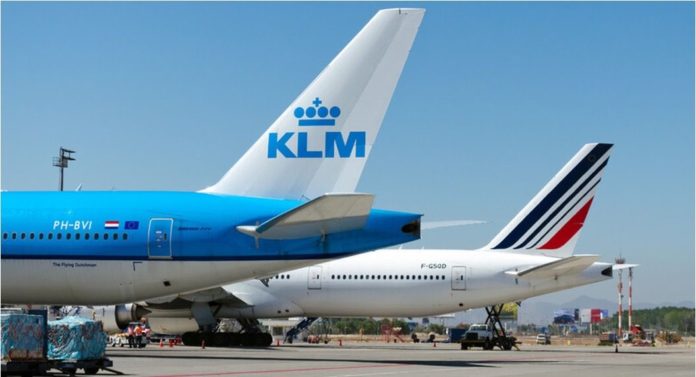
Air France-KLM has extended its partnership with WFS in North America with a new three-year passenger and ramp handing contract in Phoenix. It is the airline’s 17th destination in the US. Air France now operates three flights a week to and from Paris Charles de Gaulle.

New-look Skypallet ready for take-off

0

Airfreight tech company Wiremind says that Beta-testing of its Skypallet 2.0 space optimization and palletization tool is well underway and the significantly improved version is on tracking for launch this summer.

Skypallet 2.0 will bring a more intuitive interface, greater processing speeds, and workflow automation thanks to its integration with Wiremind’s cargo management system, Cargostack.

Wiremind says that Skypallet, launched in 2017, was the first commercial software to offer air cargo-specific 3D visualisation and optimization of pallet and container loads, addressing some of the industry’s most pressing pain points and giving commercial teams the operational know-how to quote shipments more efficiently.

For the new version, it has rewritten Skypallet’s code base in a new programming language which makes for faster calculation and more advanced palletization algorithms. Integration into Cargostack also allows deeper integration and significant workflow automation.

It also includes new data points that can be used by the palletization engine such as freight status or its build characteristics on an inbound leg to produce more granular results.

Wiremind chief executive Nathanaël de Tarade said: “Various improvements to Skypallet over the years means it is now used at multiple touchpoints and processes in the air cargo lifecycle by our customers. While Skypallet has already been integrated to customer systems through its API, it has remained a ‘stateless’ application relying on external systems to provide shipment and capacity inputs per calculation. By incorporating it into Cargostack as part of our version 2.0, we now have the architecture to retrieve and hold all the relevant inputs consumed by the palletization algorithm, through deep integration with a customer’s core reservation system.”

He added that this means that Skypallet can run autonomously in the background using the booking, flight and aircraft data to recommend outputs back to the airline system such as remaining available volume, suggest offloads and significantly automate the flight release process. Wiremind is also exploring new use cases with early adopter customers including a new module to manage end-to-end special load processes, in-warehouse use for build planning and execution, and aircraft weight and balance capabilities.

With the 2.0 improvements, Wirelmind says that Skypallet can be used throughout the entire cargo lifecycle from quotation to booking acceptance, capacity control, flight release, through to operations. It will be progressively rolled out to new and existing customers over the coming 12-18 months with a comprehensive change management plan.

AMI on the move in Cape Town

0

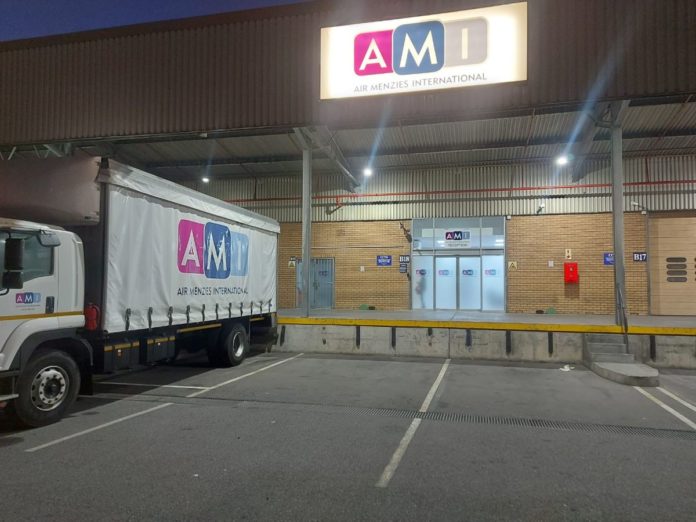
Wholesale freight forwarder Air Menzies International (AMI) has moved to a larger, modern facility in Cape Town, South Africa. Locateda short distance from the international airport, it offers faster transit times, reduced handling of shipments and is closer to airline handling agents.

It also offers additional warehouse space and features advanced cooler and freezer facilities equipped with temperature control loggers for perishable goods

The premises are monitored 24/7 with comprehensive CCTV surveillance and controlled access.

AMI chief executive Carlos Font said: “This impressive new facility is an important leap for AMI South Africa, as we continue to strengthen our value proposition and our ability to serve our clients.”

Environmental accolade for Turkish Cargo

0

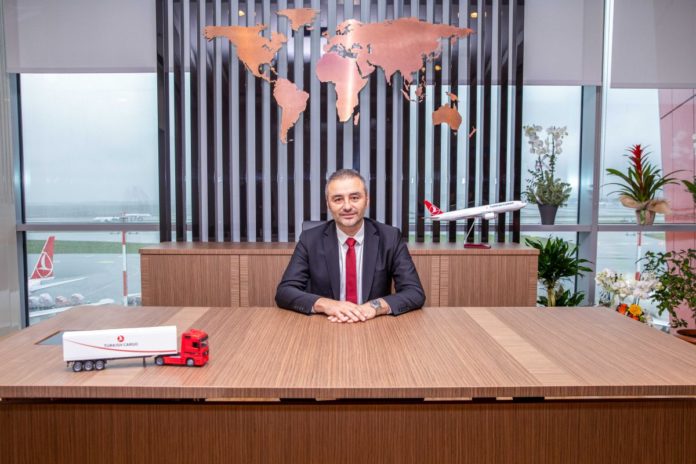
Turkish Cargo has gained LEED (Leadership in Energy and Environmental Design) platinum operations certification for its SmartIST cargo facility in Istanbul. The programme is designed to enhance the energy, water, material and interior quality and reduce environmental impact. The carrier’s chief cargo officer, Ali Turk, said: “We are committed to ensuring that the SMARTIST cargo facility not only enjoys its high capacity and cutting-edge technology, but also is a sustainable and people-oriented building.”

Emirates trains cargo managers of the future

0

Emirates SkyCargo has launched a bespoke training programme to equip the cargo leaders of tomorrow with commercial and leadership skills.

Two groups of 16 are being chosen from Emirates SkyCargo’s pool of cargo managers and include both Emirati nationals as well as others from the airline’s outstations. The 15 day programme includes six sessions, focussed on proactive preparation and strategic optimization of current and future operations, including artificial intelligence (AI). The candidates will graduate with a diploma endorsed by AviationNOW, a member of The International Air Cargo Association (TIACA.

Training is hosted at Emirates headquarters in Dubai, and will be a mix of theoretical and practical sessions. Following the first schedule, Emirates SkyCargo plans to extend the training programme to other aspects of the business, including operations.

WestJet adds US and Korea routes

0

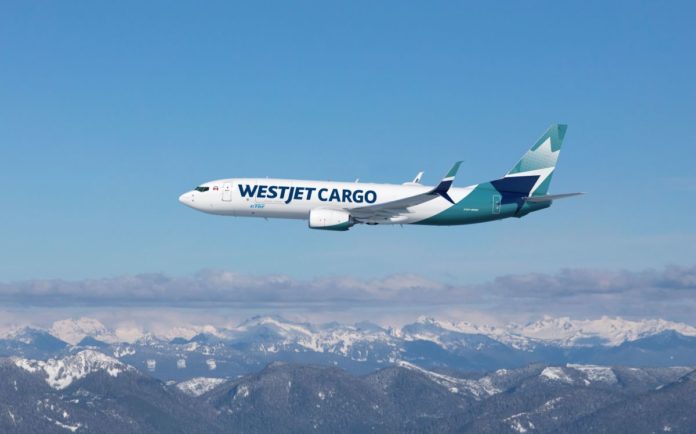
Canadian carrier WestJet Cargo is launching services to Chicago (ORD), Moncton (YQM), and Incheon (ICN) in its summer schedule.

The Chicago route operates from Calgary three times a week but will increase to daily flights by June 17 and will continue to operate year-round. The 737 aircraft have cargo capacity of 2,700 kg per flight, focusing on perishables. WestJet already operates a weekly freighter into Chicago.

Flights to Moncton, Canada, will also operate year-round with a 737 aircraft, with daily flights to Calgary, 3- 4 weekly flights to Edmonton, and 3-5 weekly flights to Toronto. The primary cargo for this route is live animals.

The Calgary to Incheon route, launched on May 18, operates three days weekly with a 787 Dreamliner, offering a 60 tonnes capacity.